
THE

NOVEL ENGINEERING & ROBOTIC DEVICES

LAB

Our mission

  • We use novel materials & fabrication techniques to design, build, and study new bioinspired actuators, robotic systems & devices.
  • “Who are we, if not measured by our impact on others? That’s who we are! We’re not who we say we are, we’re not who we want to be – we are the sum of the influence and impact that we have, in our lives, on others." - Carl Sagan
  • Research interests

  • Modular robot architecture
  • Soft actuators
  • Novel robot actuators
  • Fluidic systems design and control
  • Bioinspired locomotion and manipulation
  • Robots for entertainment and inspiration
  • Biodegradable robots
  • Self-assembling robotic systems
  • Who are we?

    DR. Matthew Robertson

    Assistant Professor
    Mitchell Professor of Soft and Multi-Material Robotics
    Mechanical and Materials Engineering Department
    Ingenuity Labs
    Queen's University

    Dr. Matthew Robertson is active in the fields of bioinspired, soft, and multi-material robotic systems design. His work is dedicated to redefining the boundaries of performance, morphology, and applications of robots that can operate in more complex and challenging “real world” environments by utilizing advanced manufacturing, embedded control, and holistic system design techniques. His past work has involved the use of novel and smart materials - silicone polymers, fiber-reinforced composites, shape memory alloys - as well as diverse and unique fabrication methods - laser micromachining, layer-manufacturing, heat bonding, casting - to develop and study novel robotic platforms. He has published work in several high impact scientific journals including Science Robotics, Soft Robotics, and the International Journal of Robotics Research and has presented at a number of international robotics conferences. Dr. Robertson received his PhD from the École Polytechnique Fédérale de Lausanne in Switzerland in the area of robotics in 2019, following a Master’s degree from the University of Michigan, and Bachelor’s degree from the Massachusetts Institute of Technology in Mechanical Engineering. In 2020, Dr. Robertson joined the faculty at Queen’s University in Canada as an assistant professor in the Mechanical and Materials Engineering Department. He currently serves as an associate editor for the International Journal of Robotics Research (IJRR).

    Graduates


    Diancheng Li PhD student
    BEng: Harbin Institute of Technology (Shenzhen)
    Graziella Bedenik PhD student
    MEng
    BASTIAAN HAGEN MASc
    BEng: Queen’s University
    TRIFKO BASIC MASc
    BEng: Queen’s University
    CHARLES DRYSDALE MASc
    BEng: Queen’s University

    Undergraduates


    PHOEBE TAN URA
    FlipWalker 2021
    LUNA ZOU URA
    Robotic medical simulator manikin 2021-2022
    CAMERON ESTABROOKS URA
    CPR training manikin Summer 2021
    HANNAH MILLS URA
    CPR training manikin Summer 2021

    Alumnus


    CAMERON ESTABROOKS URA
    CPR training manikin Summer 2021
    HANNAH MILLS URA
    CPR training manikin Summer 2021
    SORSHA ASADY URA
    Pneumatic control board 2021-
    PRISKA HORNE URA
    RoboFrog 2.0 2022-
    Seletcted Publications

    Full list: Google Scholar & ResearchGate

    JOURNALS
    New soft robots really suck: Vacuum-powered systems empower diverse capabilities
    MA Robertson, J Paik
    Science Robotics 2 (9)

    Soft pneumatic actuator fascicles for high force and reliability
    MA Robertson, H Sadeghi, JM Florez, J Paik
    Soft robotics 4 (1), 23-32

    A compact modular soft surface with reconfigurable shape and stiffness
    MA Robertson, M Murakami, W Felt, J Paik
    IEEE/ASME Transactions on Mechatronics 24 (1), 16-24

    Jammjoint: A variable stiffness device based on granular jamming for wearable joint support
    S Hauser, M Robertson, A Ijspeert, J Paik
    IEEE Robotics and Automation Letters 2 (2), 849-855

    Design and computational modeling of a modular, compliant robotic assembly for human lumbar unit and spinal cord assistance
    G Agarwal, MA Robertson, H Sonar, J Paik
    Scientific reports 7 (1), 1-11

    RoboScallop: a bivalve inspired swimming robot
    MA Robertson, F Efremov, J Paik
    IEEE Robotics and Automation Letters 4 (2), 2078-2085

    Soft pneumatic actuator-driven origami-inspired modular robotic “pneumagami”
    MA Robertson, OC Kara, J Paik
    The International Journal of Robotics Research, 0278364920909905

    CONFERENCES
    Practical control methods for vacuum driven soft actuator modules
    MA Robertson, J Paik
    2017 IEEE/RSJ International Conference on Intelligent Robots and Systems (IROS), pp.1224-1229, 24-28 Sept. 2017

    Modeling vacuum bellows soft pneumatic actuators with optimal mechanical performance
    W Felt, MA Robertson, J Paik
    2018 IEEE International Conference on Soft Robotics (RoboSoft), 534-540

    Low-inertia vacuum-powered soft pneumatic actuator coil characterization and design methodology
    MA Robertson, J Paik
    2018 IEEE International Conference on Soft Robotics (RoboSoft), 431-436

    Bi-modal control of vacuum-powered soft pneumatic actuators with embedded liquid metal-based strain sensitive skin
    MA Robertson, L Dejace, SP Lacour, J Paik
    2019 2nd IEEE International Conference on Soft Robotics (RoboSoft), 217-221

    Trunk postural tracking of assistive soft pneumatic actuator belt
    MA Robertson, J Paik
    Dynamic Walking Conference 2016

    A low-cost, actuated passive dynamic walker kit for accessible research and education
    MA Robertson, J Paik, A Ijspeert, A Wu
    Dynamic Walking Conference 2017

    Our research


    Our research is generally categorized into the three areas shown below - Soft Robotics, Novel Actuators, and Mobile Robots - however most of our work extends across multiple categories and quite often beyond, leveraging knowledge and techniques from many disparate domains including biology, biomechanics, materials science, manufacturing, and industrial design.

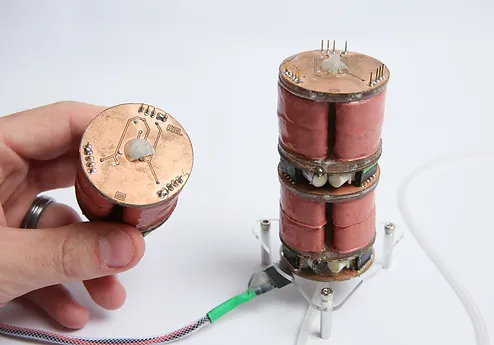
    Modular vacuum-powered actuators

    Compliant systems or components afford many advantages across current and future potential applications for robotics, including locomotion, manipulation, human-robot interaction, and wearable devices. Our research interest in this area is to explore the vast design space beyond traditional robot system compositions by leveraging soft and smart materials to achieve robots with unique form factors, functional behaviors, and innate characteristics which render new and previously inaccessible applications and opportunities in robotics.

    Really Suck


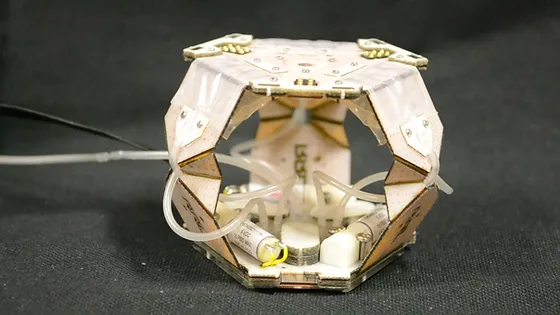
    Modular origami-inspired robots

    Actuators are the fundamental component of any mechanical robotic system responsible for performing physical work, and are thereby one of the most important elements of a robot's design. As the performance and behavioral characteristics of the actuators inherently dictate those of any robot overall, the design of a robotic system is often centered around a choice of actuators from readily available options or includes the careful design of a customized actuator to meet the specifications of desired performance objectives.

    Pneumagami

    Let’s Keep In Touch

    NERD RESEARCH LAB FACILITIES
    Nicol Hall - Main lab HQ - MME Department
    Mitchell Hall - Collaborative space - Ingenuity Labs
    McLaughin Hall - Collaborative space - MME Department

    Address:
    130 Stuart St
    Kingston ON K7L 3N6

    Email: m.robertson AT queensu DOT ca

    " width="100%" height="422px" frameborder="0" style="border:0" allowfullscreen>